
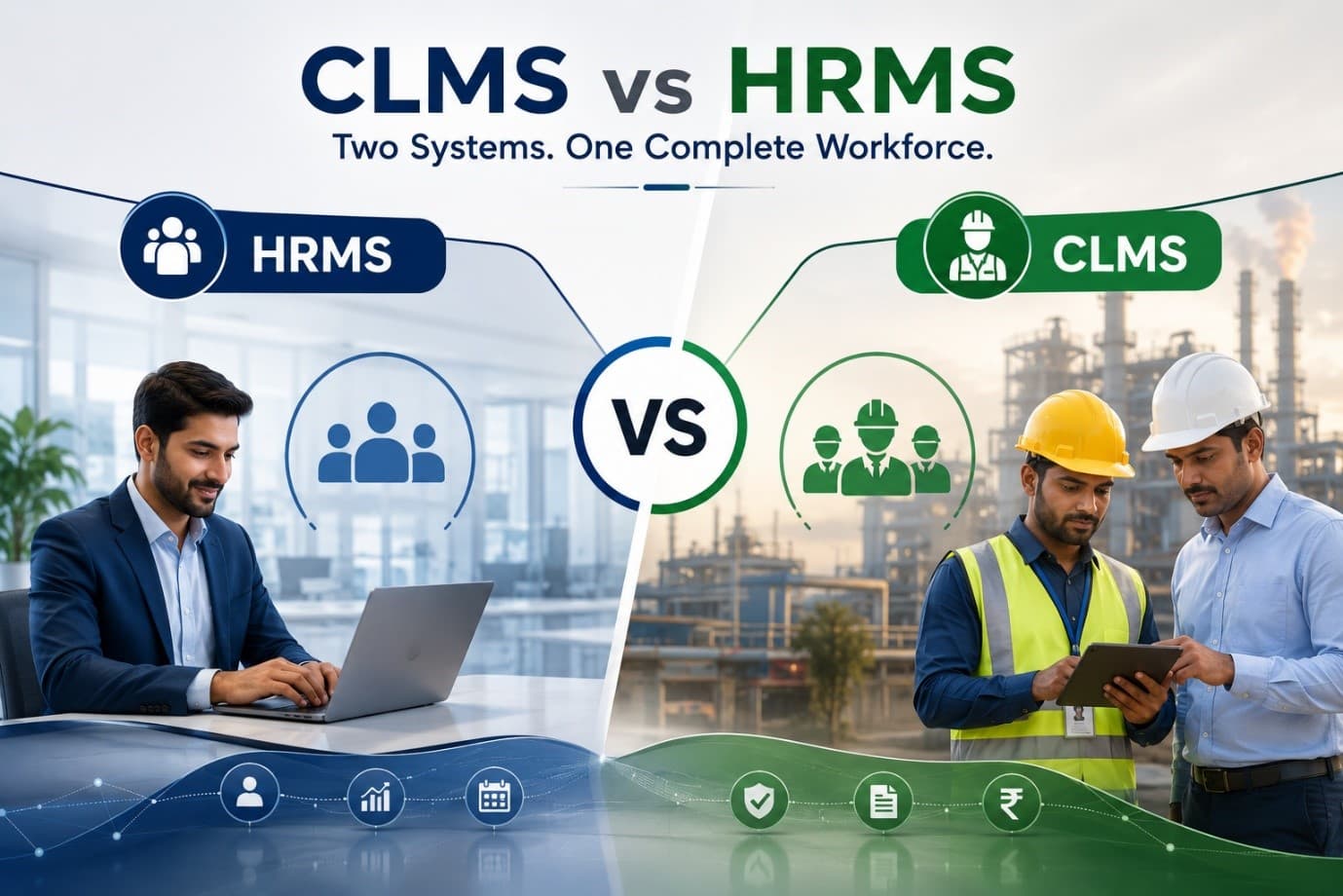
Summary
Managing a modern workforce requires more than just an HRMS. While an HRMS is designed to manage permanent employees, a Contract Labour Management System (CLMS) governs the entire contract workforce from contractor onboarding and compliance to attendance, wage verification and contractor billing. This article covers the key differences between CLMS and HRMS, when each system is needed, and why organisations with a large contract workforce benefit from using both together.
CLMS vs HRMS: one workforce, two different systems
Managing today's workforce is no longer just about employees.
Across manufacturing, automotive, pharmaceuticals, electronics, logistics, FMCG, engineering and industrial sectors, organisations rely on hundreds or even thousands of contract workers supplied by multiple contractors.
Every day, these workers enter factory premises, work across shifts, generate attendance records, earn wages and contribute directly to business operations.
Yet many organisations still attempt to manage them using only an HRMS (Human Resource Management System).
The result:
- Compliance risks
- Payroll discrepancies
- Unauthorised worker access
- Invoice disputes
- Manual audits
- Lack of workforce visibility
This is where a Contract Labour Management System (CLMS) becomes essential.
While both HRMS and CLMS are workforce management solutions, they serve completely different purposes. Understanding the difference is critical for organisations looking to improve compliance, streamline operations and gain complete control over their workforce.
The modern workforce has changed
Today's industrial workforce is made up of two distinct groups:
Permanent employees
Managed directly by the organisation through HR policies and payroll.
Contract workforce
Managed through contractors, staffing agencies, labour suppliers and third-party vendors.
While permanent employees may represent one part of the workforce, contract workers often make up a significant share of manpower in manufacturing and industrial operations.
The challenge is that managing contract labour involves much more than attendance and payroll. It requires governance across contractors, statutory compliance, security, finance, operations and audits.
This is why organisations need more than just an HRMS.
What is an HRMS?
A Human Resource Management System (HRMS) is designed to manage the lifecycle of permanent employees.
It helps HR teams automate day-to-day employee processes such as:
- Recruitment and hiring
- Employee onboarding
- Attendance and leave management
- Payroll processing
- Performance management
- Learning and development
- Employee self-service
- Exit management
- HR analytics
An HRMS provides a centralised platform for managing employee information, improving HR efficiency and ensuring a seamless employee experience.
However, HRMS platforms are primarily built for employees who are directly on the payroll.
What is a Contract Labour Management System (CLMS)?
A Contract Labour Management System (CLMS) is a specialised platform designed to manage the complete lifecycle of contract workers and contractors.
Instead of focusing only on individuals, a CLMS governs the entire contract workforce ecosystem.
A modern CLMS enables organisations to:
- Onboard contractors digitally
- Register contract workers
- Verify worker identities
- Perform background verification
- Validate contractor licences
- Monitor statutory compliance
- Track PF and ESIC submissions
- Capture biometric attendance
- Manage shifts and overtime
- Verify wages
- Reconcile contractor invoices
- Generate audit-ready reports
- Control workforce entry based on compliance status
In short, a CLMS transforms contract labour management into a structured, transparent and compliant process.
CLMS vs HRMS: key differences
| Feature | HRMS | CLMS |
|---|---|---|
| Primary workforce | Permanent employees | Contract labour |
| Managed by | HR department | HR, operations, security, finance and compliance |
| Employee onboarding | Yes | Limited |
| Contractor onboarding | No | Yes |
| Worker registration | No | Yes |
| Contractor management | No | Yes |
| Attendance | Employee attendance | Contract workforce attendance |
| Leave management | Yes | Shift and attendance validation |
| Payroll | Employee payroll | Wage verification |
| PF and ESIC validation | Employee records | Contractor compliance |
| Background verification | Limited | Comprehensive |
| Contractor billing | No | Yes |
| Invoice reconciliation | No | Yes |
| Gate access integration | Limited | Yes |
| Audit reports | HR audits | Labour compliance audits |
Although both systems contribute to workforce management, they address entirely different operational challenges.
Why HRMS alone isn't enough
Many organisations assume their HRMS can also manage contract labour.
In reality, contract workforce management involves multiple stakeholders beyond HR.
Security teams need to know who is authorised to enter the premises.
Operations teams need visibility into workforce availability.
Finance teams must verify contractor invoices before payment.
Compliance teams need to monitor statutory obligations under labour laws.
Without a dedicated CLMS, these responsibilities often become fragmented across spreadsheets, emails and manual registers.
The result is reduced visibility and increased operational risk.
Common challenges without a CLMS
Compliance risks
Keeping track of contractor licences, labour registrations, insurance documents, PF, ESIC and statutory records manually is time-consuming and prone to errors.
Missing even a single document can result in compliance violations during audits or inspections.
Unauthorised workforce access
Workers may enter the premises despite:
- Expired contractor licences
- Incomplete background verification
- Missing mandatory documents
- Shift mismatches
- Blacklisting
- Contract expiry
Without automated validation, security teams often have limited visibility into worker eligibility.
Payroll and wage disputes
Manual attendance tracking can lead to:
- Incorrect overtime
- Duplicate attendance
- Ghost workers
- Wrong wage calculations
- Contractor disputes
- Delayed invoice approvals
These errors directly impact finance operations and vendor relationships.
Limited workforce visibility
Managing multiple contractors across several plants often results in scattered information.
Different teams maintain different records, making it difficult to answer simple questions such as:
- How many contract workers are currently on-site?
- Which contractor has expired licences?
- Who has pending compliance?
- Which workers have completed background verification?
Without centralised visibility, decision-making becomes reactive rather than proactive.
How a CLMS solves these challenges
A modern Contract Labour Management System automates the complete contract workforce lifecycle.
Step 1: digital contractor onboarding
Every contractor is onboarded with agreements, licences, statutory registrations and compliance documents.
Step 2: worker registration and background verification
Workers are digitally registered with identity documents, photographs, biometric data and background verification.
Step 3: compliance validation
Before a worker enters the premises, the system validates:
- Contractor licence
- Worker documents
- PF and ESIC status
- Background verification
- Mandatory compliances
Step 4: intelligent attendance
Attendance is captured through biometric devices, facial recognition, QR code or mobile applications while validating shift schedules and overtime eligibility.
Step 5: wage verification
The system calculates attendance, overtime, holidays, weekly offs and wage components to ensure accurate contractor payments.
Step 6: invoice reconciliation
Attendance, wages, statutory compliance and contractor invoices are automatically matched before approvals, significantly reducing manual effort.
Step 7: audit readiness
Every attendance record, compliance document, worker movement and invoice is digitally stored, making labour audits faster and more transparent.
Benefits of implementing a Contract Labour Management System
Organisations implementing a CLMS experience significant operational improvements.
Improved compliance
Automatically monitor statutory obligations, contractor licences and labour documentation to reduce compliance risks.
Better workforce visibility
Gain real-time visibility into contractors, workers, attendance, compliance status and workforce deployment across locations.
Accurate wage verification
Eliminate payroll disputes with automated attendance validation and overtime calculations.
Faster contractor billing
Reduce invoice processing time by reconciling attendance, compliance and wage data automatically.
Stronger security
Allow only authorised and compliant workers to access facilities through intelligent access validation.
Audit-ready records
Maintain complete digital documentation that simplifies inspections and statutory audits.
Industries that benefit most from CLMS
A Contract Labour Management System is particularly valuable for industries with a large outsourced workforce.
- Automotive manufacturing
- Electronics manufacturing
- Pharmaceutical companies
- Chemical plants
- Engineering and heavy industries
- Warehousing and logistics
- FMCG manufacturing
- Food processing
- Infrastructure projects
- Renewable energy
- Mining and metals
- Industrial parks
If your organisation manages multiple contractors or contract workers, a CLMS can significantly improve governance and operational efficiency.
Can CLMS and HRMS work together?
Yes, and they should.
Rather than replacing an HRMS, a CLMS complements it by managing the contract workforce while the HRMS continues to manage permanent employees.
A typical workforce ecosystem looks like this:
HRMS manages:
- Permanent employees
- Employee payroll
- Recruitment
- Leave
- Performance management
- Employee records
CLMS manages:
- Contractors
- Contract workers
- Compliance
- Attendance validation
- Background verification
- Wage verification
- Contractor billing
- Audit readiness
- Workforce governance
Together, they provide organisations with complete workforce visibility and operational control.
Why choose InOps for contract labour management?
InOps is an AI-powered Contract Labour Management System (CLMS) built for modern enterprises that rely on contract labour.
With InOps, organisations can:
- Digitally onboard contractors and workers
- Automate contractor compliance
- Validate PF and ESIC records
- Perform AI-enabled background verification
- Capture biometric and facial recognition attendance
- Enforce conditional gate access
- Automate wage verification
- Reconcile contractor invoices
- Monitor workforce compliance in real time
- Access audit-ready dashboards and reports
InOps enables HR, operations, finance, security and compliance teams to work from a single source of truth, helping organisations reduce risk while improving workforce efficiency.
As organisations increasingly depend on outsourced manpower, managing contract labour requires more than traditional HR tools.
While an HRMS remains essential for managing permanent employees, it cannot address the complexities of contractor governance, labour compliance, workforce security or invoice reconciliation.
A Contract Labour Management System (CLMS) fills this gap by providing complete visibility into contractors, workers, compliance, attendance, wages and billing.
By using CLMS alongside HRMS, organisations can build a connected workforce ecosystem that improves compliance, strengthens security, reduces financial leakage and supports smarter operational decisions.
Discover how InOps helps manufacturers and enterprises automate contractor onboarding, workforce compliance, attendance, wage verification and contractor billing — all from one unified platform.
Frequently asked questions
- Is CLMS different from HRMS?
- Yes. HRMS manages permanent employees, while CLMS manages contractors, contract workers, compliance, attendance, wages and contractor billing.
- Why do manufacturing companies need CLMS?
- Manufacturers typically engage hundreds or thousands of contract workers. A CLMS helps automate compliance, improve attendance accuracy, verify wages, manage contractor performance and simplify audits.
- Can CLMS integrate with existing HRMS software?
- Yes. Modern CLMS platforms integrate seamlessly with HRMS, ERP, payroll systems, biometric devices, access control systems and finance applications.
- What are the biggest benefits of a CLMS?
- Key benefits include contractor compliance management, digital onboarding, automated attendance, wage verification, invoice reconciliation, workforce visibility, audit readiness and intelligent access control.
- Does a CLMS replace an HRMS, or do organisations need both?
- A CLMS complements an HRMS — it does not replace it. An HRMS manages the lifecycle of permanent employees: recruitment, onboarding, payroll, leave, performance, and exit. A CLMS manages the contract workforce ecosystem: contractor onboarding, worker registration, statutory compliance, biometric attendance, wage verification, invoice reconciliation, and audit readiness. In a manufacturing or industrial setting where a significant share of the workforce is contract labour, both systems are necessary — the HRMS for direct employees and the CLMS for contractors and their workers. Organisations that attempt to manage contract labour through their HRMS typically face compliance gaps, invoice disputes, and limited workforce visibility, because HRMS platforms are not designed for the multi-party, multi-contractor compliance obligations of the Contract Labour (Regulation & Abolition) Act.