What Is Earned Wage Access? A Guide for Indian Employers
Earned Wage Access lets workers draw part of the wages they have already earned before payday. How it works in India, who pays, and what employers need to set it up.
Blog
Featured story
Our editor's pick on what is changing in contract labour compliance, CLRA enforcement, and workforce technology for Indian manufacturers.
Earned Wage Access lets workers draw part of the wages they have already earned before payday. How it works in India, who pays, and what employers need to set it up.
More articles
Workforce tech, compliance, and secure access curated for operators and people leaders.
Earned Wage Access, salary advances and payday loans all put cash in a worker's hands before payday. They differ on who funds them, what they cost and what happens if things go wrong.
Early salary access helps workers meet bills on time, avoid moneylenders and plan better. Ten benefits for gig and blue-collar workers, and what they mean for employers.
Employees keep asking for salary advances, and each one ties up company cash. How Indian employers and contractors can offer early pay without funding it themselves.
Delivery partners spend on fuel, phone data and vehicle EMIs every day but are paid weekly or every 15 days. How Earned Wage Access closes that gap for riders and platforms.
Rider churn drives up hiring and onboarding costs for delivery platforms. Why riders leave, and how giving them access to earnings before payout keeps them active.
Many gig workers borrow at high interest just to get through the pay cycle. Why the debt cycle starts, what it costs workers and employers, and how Earned Wage Access helps.
How do you know if your gig workforce is healthy? Five signs operations and HR leaders should track, from first-month retention to earnings visibility.
Demand spikes, festival seasons and monsoons test every gig workforce. Five practical ways to build one that holds up, from onboarding to pay access.
Gig work offers flexibility, but often at the cost of financial security. What a sustainable gig job looks like, and the role employers and platforms can play.
Gig work is growing fast in India's Tier 2 and Tier 3 cities. Lower savings, fewer formal credit options and family obligations make access to earnings even more important there.
More women are joining India's gig and blue-collar workforce. Why control over their own earnings matters, and how employers can make work more financially secure for them.
Many gig workers in India are paid every 15 days, but their expenses come daily. What happens in that gap, what it costs workers and companies, and how Earned Wage Access closes it.
Should you pay your workforce weekly, every 15 days or monthly? The trade-offs in admin, cost and retention, and how Earned Wage Access changes the decision.
Gig workers pay for fuel, mobile data, food and vehicle costs every day, but are paid every week or two. A look at the daily costs of gig work and how early access to earnings helps.
Blue-collar workers in India often leave for small differences in pay or benefits. What they actually value, and which low-cost benefits keep them on the shop floor.
Flexible work is mostly a white-collar benefit. For blue-collar workers, who need to be on site, flexible pay may matter more. What flexible pay means and how to offer it.
HR teams track attrition, absenteeism and engagement. Financial stress drives all three. Why financial wellness is becoming an HR metric, and how to measure it for a blue-collar workforce.
How to build the business case for a financial wellness programme for blue-collar and contract workers: which costs it reduces, how to measure them, and a simple ROI method.
A practical checklist for plant HR to review benefits for blue-collar and contract workers: statutory basics, pay access, health, safety and communication.
Most blue-collar and gig workers have no savings to fall back on. Four layers employers can put in place to build a financial safety net, from pay access to insurance.
Pay disputes and opaque deductions erode trust between workers, contractors and employers. How transparent earnings and Earned Wage Access rebuild it.
Gig workers need credit, but the wrong kind can trap them in debt. Five principles for platforms, employers and lenders offering credit or wage access to gig and blue-collar workers.
What recent Union Budgets announced for India's gig and platform workers: ID cards, e-Shram registration and PM-JAY health cover. What it means for platforms and employers.
Karnataka's Platform-based Gig Workers (Social Security and Welfare) law sets up a welfare board, worker registration and a welfare fee on aggregators. What platforms operating in Karnataka should know.
Workers are being offered loans by apps, moneylenders and lenders tied to employers. What employers should know before endorsing any credit or wage access product for their workforce.
Millions of blue-collar workers have no credit score but years of verified attendance. How work data can help them access fair credit, and what it takes to do it responsibly.
Earned Wage Access uses sensitive attendance, payroll and bank data. How InOps protects that data, and what ISO/IEC 27001 certification means for employers using Salary++.
Who funds a Salary++ advance, who recovers it, and who carries the risk? A plain explanation of the NBFC partner model behind Salary++ Earned Wage Access.
Contract workers are paid by the contractor, not the principal employer. How Earned Wage Access works when the contractor runs payroll, and how to avoid disputes between worker, contractor and site.
Informal cash advances from contractors cause disputes, underpayment and audit risk. How principal employers can replace them with traceable Earned Wage Access.
Blue-collar and contract workers juggle paper payslips, attendance disputes and advance requests. Why a single worker app for attendance, payslips and wage access works better.
Does offering Earned Wage Access cost the employer money? What employers pay, what they don't, and the hidden costs of not offering it.
How do Earned Wage Access programmes prevent fake attendance, over-withdrawal and account misuse? The controls employers should expect, and the questions to ask any EWA provider.
A practical day-by-day checklist for launching an Earned Wage Access pilot in a week: data, policy, contractors, worker onboarding and the first payroll.
Security guards and housekeeping staff work across many client sites and are often paid late. How Earned Wage Access helps facility management companies retain staff and win contracts.
Warehouse, dark store and 3PL workers face peak-season pressure, shift work and high churn. How Earned Wage Access helps logistics operators keep pickers, packers and loaders.
Migrant workers send money home regularly and face extra costs in a new city. How Earned Wage Access helps them meet family needs on time, and why it matters to employers.
Festival advances are a tradition in Indian workplaces, but they strain cash flow and often lead to debt. How Earned Wage Access helps workers meet festival costs from their own earnings.
Some months hit workers harder: school admissions, monsoon illness, family emergencies. A calendar of high-need periods and how employers can prepare with Earned Wage Access.
Every year, many blue-collar and migrant workers go home for festivals and do not come back. Why post-festival attrition happens, and how Earned Wage Access helps bring workers back.
RD Service means Registered Device Service: UIDAI's rule that Aadhaar biometric devices encrypt data at capture. When you need it, and when you don't.
Fingerprint attendance systems fail on the hands of people who do manual work. Face recognition costs more per device and less per year. Here's the honest comparison for Indian manufacturing, with the conditions that decide it.
eSSL and ZKTeco are the two most widely deployed biometric device brands in Indian industry. Here's how they compare on device range, software, support and total cost — and why the brand matters less than what you connect it to.
Contract Labour ManagementIs your factory still managing contract workers through Excel? Discover 10 signs your contractor management process needs automation, better compliance and real-time workforce visibility.
Biometric device pricing varies far more than it should, and most vendors won't say why. Here's what drives the cost — modality, environment rating, throughput, connectivity — plus the costs quotations routinely omit.
Attendance management software built for offices doesn't hold up in manufacturing — shifts, contractors, multi-site operations and statutory records need a different set of capabilities. Here's what to evaluate.
A paper visitor register cannot survive an audit. Here's how a visitor management system works for industrial sites — pre-registration, watchlist screening, zone-limited passes, and contractor and driver visits.
Vendor management for a manufacturer's contractor base means licences, insurance, renewals, headcount caps and performance — not procurement software. Here's what to track and why it matters under CLRA.
Most HR dashboards show the wrong things for a multi-plant HR head — vanity headcount totals instead of the exceptions that need attention. Here's what belongs on the dashboard, and why site comparison needs common definitions first.
Fingerprint not detected, face not recognised, device offline or not syncing? Step-by-step fixes for ZKTeco and eSSL machines, and when to call AMC.
Labour management system software governs both permanent and contract workforces on one platform — attendance, compliance, payroll and multi-site visibility. Here's what it is, what it should do, and how it differs from HRMS.
CLMS stands for Contract Labour Management System: software that runs contract workers from gate to payroll and keeps CLRA registers audit-ready.
Most factory gates check identity. Compliance requires checking nineteen things — licence validity, headcount caps, induction currency, medical fitness, shift windows and more. Here is the full list, and how to score your own gate.
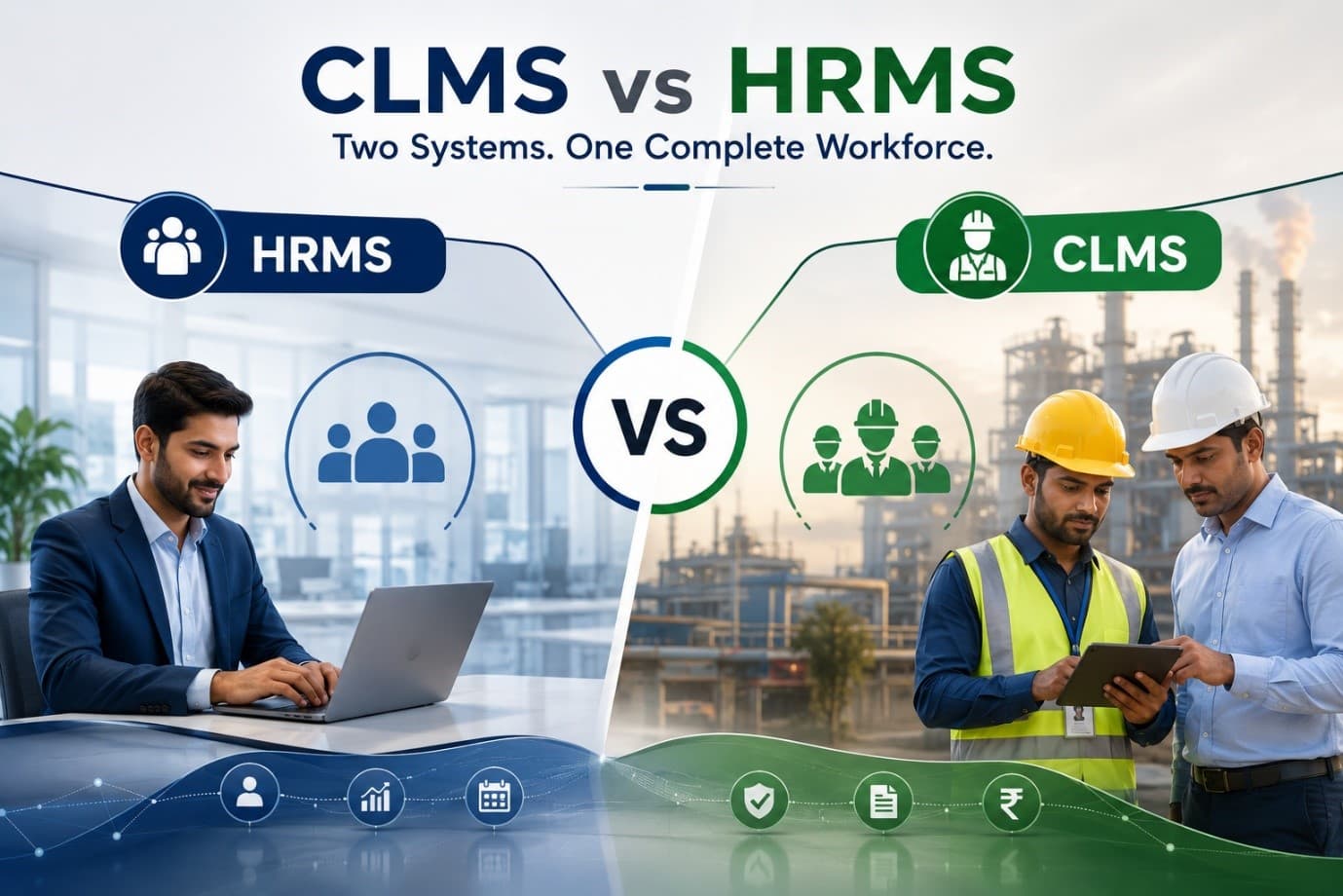
Contract Labour ManagementLearn the key differences between CLMS and HRMS, and why manufacturers need both for compliance, contractor management and audit readiness.
The eight access control trends reshaping industrial site security in India: biometric gates, mobile credentials, STQC-compliant cameras, zone-based access, contractor lifecycle controls, and CLRA-linked audit trails.
How biometric attendance — face recognition and fingerprint — is eliminating proxy punching, closing contractor billing gaps, and building CLRA compliance records automatically across Indian manufacturing sites.
Six software and workflow trends changing how Indian manufacturing plants capture, validate, and use time and attendance data: CCTV validation, mobile punch, automated shift rules, contractor reconciliation, statutory exports, and exception dashboards.
How integrated HR technology — self-service, earned wage access, unified attendance-payroll, contractor visibility, and compliance dashboards — improves retention, reduces help-desk load, and drives engagement for manufacturing workforces in India.
Face recognition terminals and CCTV cameras record who entered your factory. But attendance data is only compliance data when it is linked to CLRA records, OT verification, and contractor billing. Here's how InOps CLMS connects the camera to the compliance stack.
A complete CLRA compliance checklist for principal employers in India — Form V, Form XIII, headcount limits, wage registers, PF/ESI, and the 9-day attendance rule that triggers permanent employment liability.
A complete guide to Form V (commencement certificate) and Form XIII (Register of Contractors) under the Contract Labour (Regulation & Abolition) Act, 1970 — mandatory documentation every Indian principal employer must maintain.
Overtime fraud, unauthorised OT, and reconciliation errors drain 8–12% of contractor spend in Indian manufacturing. This explainer covers the three leakage types, the Factories Act exposure, and how biometric attendance closes each one.
When a contract worker attends continuously without a weekly off, Indian labour law may confer permanent employment rights. Here's what the rule means, when it applies, and how automated attendance tracking prevents liability.
A buyer's guide to contractor attendance tracking software for Indian manufacturers — key capabilities, integration requirements, biometric options, and the CLRA compliance features that distinguish CLMS from generic HR software.
Face recognition and biometric attendance for contractor workforces at HAL, DRDO, ISRO, and other defence/aerospace facilities — compliance requirements, hardware specifications, and how InOps manages 163+ sites including defence installations.
How ZKTeco biometric terminals integrate with a Contract Labour Management System for unified contractor attendance across 100+ manufacturing sites — device management, offline buffering, and compliance reporting.
Contractor overbilling — inflated headcount, ghost workers, and mismatched OT claims — is the leading source of contractor spend leakage in Indian manufacturing. Here's how biometric attendance and CLMS reconciliation closes it.
InOps is the only platform that links Earned Wage Access (EWA) directly to biometric attendance records — making on-demand wage disbursement for contract workers verifiable, compliant, and fraud-free.
Anonymized compliance data from 163+ Indian manufacturing sites reveals the most common CLRA violations, PF/ESI gaps, and contractor onboarding failures — and what top-quartile plants do differently.
AllInOps platform data from Indian manufacturing sites quantifies overtime leakage — unclaimed OT, unauthorised OT, and reconciliation errors — and shows the corrective patterns that close the gap.
Analysis of InOps biometric device fleet data from Indian factories — face recognition accuracy rates, common failure modes, and the attendance-to-payroll leakage they create when left uncorrected.
Need an operator view?
Talk to our team about biometric attendance, access control, and HR integrations tailored to your sites.